

Magnesium appears on many labels — but behind it hide very different compounds. Magnesium never goes into a capsule in elemental form, but always bound: to an acid, an amino acid or as a salt. Which bond it is determines solubility, tolerability and how much elemental magnesium is actually contained.
The seven forms at a glance
Magnesium citrate — bound to citric acid, the organic form with high solubility.
Magnesium bisglycinate — bound to the amino acid glycine, the gentle, stomach-friendly form.
Magnesium gluconate — bound to gluconic acid, a highly soluble organic form.
Magnesium glycerophosphate — bound to glycerophosphate, the fat-soluble organic component.
Magnesium oxide — the compact depot form: a lot of elemental magnesium in little space.
Magnesium carbonate — the alkaline form, rounding off the spectrum.
Magnesium chloride — the salt-like, very readily water-soluble form.
Why the combination?
Each compound brings different properties. A mix of organic and inorganic forms combines fast solubility with a compact magnesium content — NUI Magnesium 7 contains 500 mg of elemental magnesium per daily serving (133 % NRV) from seven sources.
How to take it: it doesn’t get simpler
Two capsules daily with a meal, with a large glass of water. Many tie the intake to their evening routine — regularity matters more than the time of day.
Aus diesem Artikel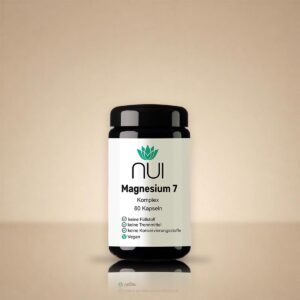
Authorised EU claims
Magnesium contributes to normal muscle function, to the reduction of tiredness and fatigue, as well as to a normal functioning of the nervous system and to normal psychological function. Food supplements are not a substitute for a balanced and varied diet.